The Business Process Continuous Improvement Process (BPCIP) provides a guide for carrying out improvement efforts in
the organization, providing a systematic way to integrate improvements opportunities found into BPs and services
implementation. It has been defined extending the BP lifecycle (Weske, 2007) with explicit measurement activities and a
BP Execution Measurement Model (BPEMM); and improvement activities based on PmCompetisoft (Pino et al., 2009).
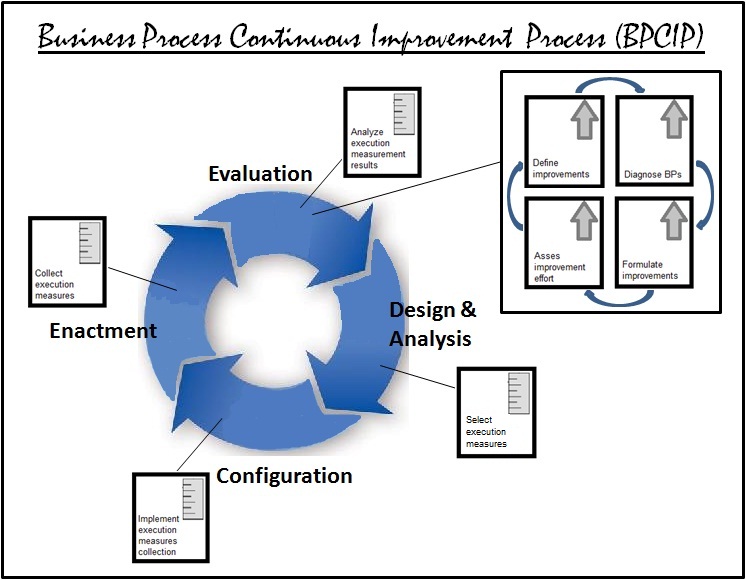
The approach consists of traversing the BPCIP lifecycle to model, validate, simulate, implement, deploy, execute,
analyze and evaluate BPs execution, including the selection, implementation, collection and calculation of the
execution measures from BPEMM.
When improvement opportunities are found based on the analysis of the data from BPs execution carried out in the
Evaluation phase, the improvement activities are executed to define the improvements to be integrated, diagnose the
BPs, and formulate the improvements, triggering a new execution of the BPCIP lifecycle to generate a new version of the
BP.
Finally, the results of executing the previous BP version and the new one are compared in order to evaluate the
improvements, and the whole improvement effort is evaluated to determine if the improvement goals have been achieved.
|

